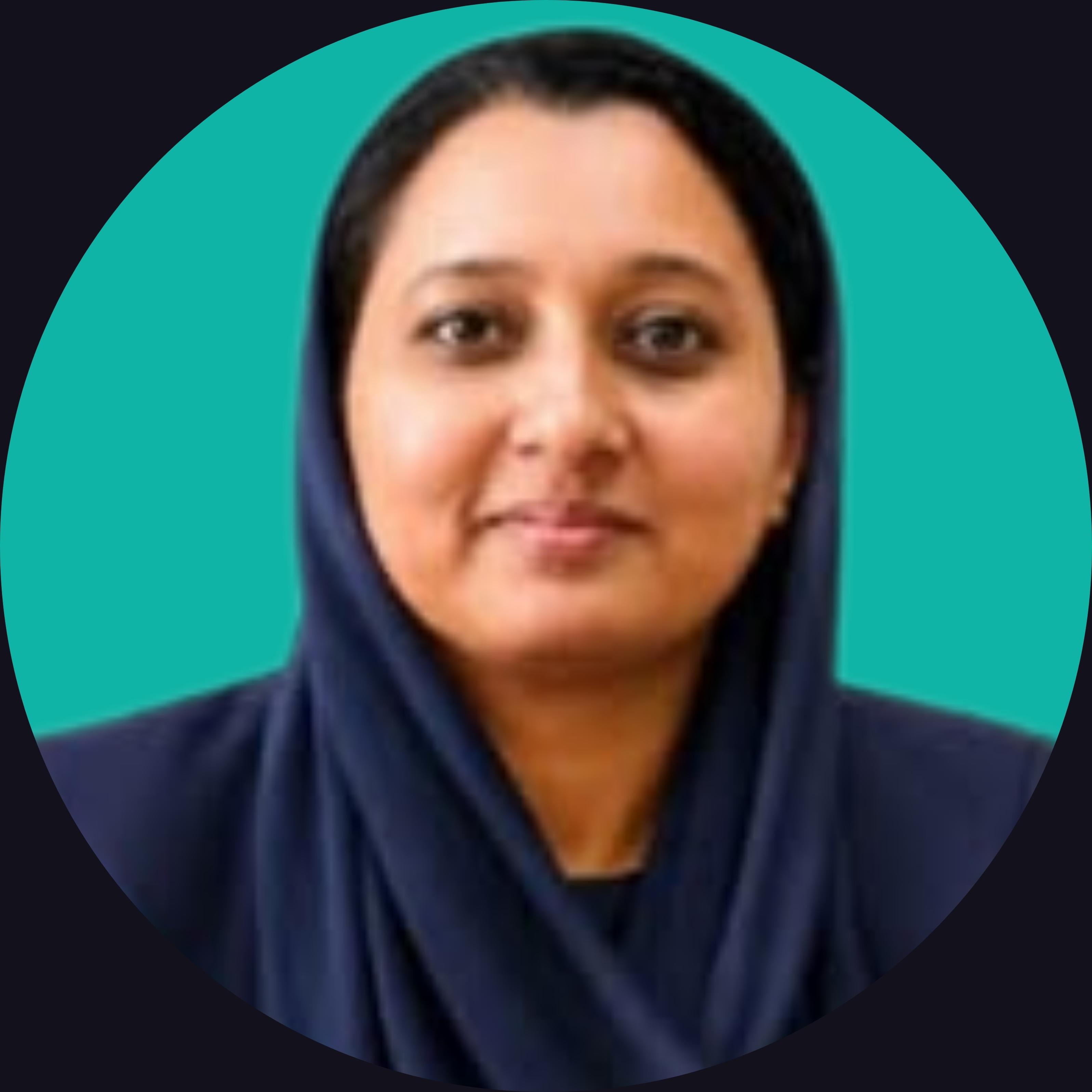
Dr. Humera Tariq is an Associate Professor of Computer Science at the University of Karachi, working at the intersection of medical imaging, deep learning, and agentic AI. Her research teaches machines to segment and interpret clinical images — from brain MRI to quantitative bone-marrow MRI — and explores how AI agents can safely support diagnosis and clinical decision-making.
Her path bridges engineering and computer science: a B.E. in Electrical Engineering from NED University, followed by an MCS, MS/M.Phil, and PhD in Computer Science at the University of Karachi, with doctoral work on skull stripping and segmentation of brain MR volumes. She has held two international postdoctoral positions — biometrics and recognition at the University of Sassari in Italy, and MRI with deep learning at the University of Michigan in the USA.
Recent work spans deep-learning bone-marrow segmentation for myelofibrosis patients (published in Frontiers in Oncology and Magnetic Resonance in Medicine) and stateful agentic-AI workflows for stroke imaging and oncology real-world evidence. She is an NVIDIA DLI Certified Ambassador and a Meta AI Master Trainer for Pakistan, an ACM / ACM-W / SIGGRAPH member, and a reviewer for journals including NeuroImage and JMRI — regularly delivering Python and PyTorch deep-learning workshops from Karachi to EPFL in Switzerland.
RoleAssociate Professor, CS
InstitutionUniversity of Karachi
PhDBrain MRI Segmentation
PostdocsMichigan (USA) · Sassari (Italy)
FocusMedical Imaging · Deep Learning · AI
Based inKarachi, Pakistan
Research focus
What I work on
Across the pipeline from raw medical images to safe, structured clinical understanding — and building the people and tools to get there.
01
Medical Image Segmentation & MRI
Brain MR volumes, skull stripping, and quantitative fat-MRI bone-marrow segmentation using U-Net and Attention U-Net architectures.
02
Deep Learning & Machine Learning
Reproducible, end-to-end PyTorch and TensorFlow pipelines for clinical imaging, from data retrieval to validated segmentation outputs.
03
Agentic AI for Healthcare
Stateful agent workflows — infarct core & penumbra segmentation on NCCT/DWI, and oncology real-world-evidence trial emulation.
04
Biometrics & Recognition
Log-polar representations for biometric verification using contrastive learning and cosine-similarity face matching.
05
Computer Graphics & Visualization
OpenGL/WebGL, 3D models and simulations, and voxel-processing pipelines for brain-volume measurement.
06
Responsible AI & Capacity Building
Prompt engineering and responsible-AI training as a Meta AI Master Trainer and NVIDIA DLI Ambassador.
Selected publications
Recent research
Peer-reviewed work in medical imaging, deep learning, and applied machine learning.
2026
On-Scanner Correction of Gradient Nonlinearity Bias for Accurate Assessment of Diffusion Heterogeneity Across Bone Sites in Myelofibrosis Patients
Malyarenko DI, Ross BD, Peeters JM, Devaraj A, Jafari R, Tariq H, et al.
Magnetic Resonance in Medicine, 95(6):3386–3395.
2025
A Deep Learning Aided Bone Marrow Segmentation of Quantitative Fat MRI for Myelofibrosis Patients
Tariq H, Hadjiiski L, Malyarenko D, Talpaz M, Pettit K, Luker GD, Ross BD, Chenevert TL.
Frontiers in Oncology, 15:1498832.
2024
A PRISMA-Driven Review of Speech Recognition Based on English, Mandarin Chinese, Hindi and Urdu Language
Khatri MH, Tariq H, Feroze M, Ali E, Junaidi ZA.
International Journal of Information Technology and Computer Science, 16(3):36–51.
A full publication list is available on
GitHub and LinkedIn.
Speaking & workshops
On stage & in the room
Invited talks, conference sessions, and hands-on deep-learning workshops delivered across Pakistan, the USA, Canada, and Europe.